Greece is the world's number-one bareboat charter destination, and for good reason. Six thousand islands, two completely different wind systems, water that shifts from Ionian turquoise to deep Aegean blue, and a mature charter infrastructure. This guide brings together everything you need to plan a sailing holiday in Greece: the six cruising areas, the winds, the season, licences and budget, with links to detailed itineraries for each region.
Why Greece
Six thousand islands and islets. Two radically different wind regimes. A dense network of charter bases. Direct flights from the UK and across Europe to Athens and to seven island or coastal airports. And a cultural richness, monuments, food and landscapes, that keeps sailors coming back year after year without ever repeating the same route.
Greece suits every level: beginners find their feet in the Ionian, experienced crews get a proper workout in the Cyclades, and intermediates strike the balance in the Saronic Gulf or the Sporades.
The six sailing areas
The Ionian Islands, for all levels
The ideal first charter. The Maestro, a predictable NW thermal breeze of 10 to 18 knots, blows from June to September. The water is the calmest in Greece and the islands sit less than 30 miles apart. Nidri (Lefkada) is the largest charter base in the country, 20 minutes from Preveza airport.
The Saronic Gulf, maximum logistics
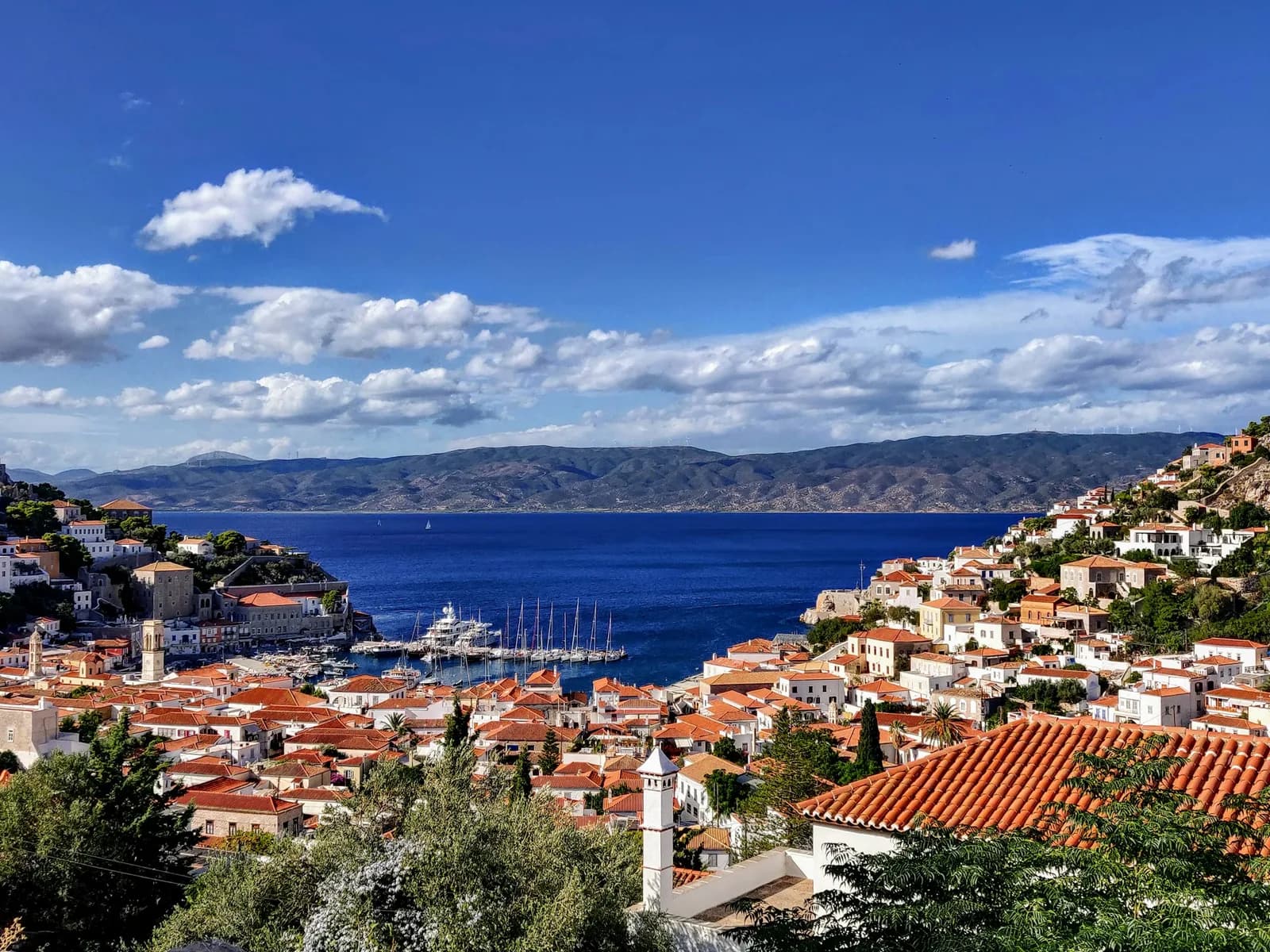
Greece's gateway. Athens airport plus 30 minutes to Lavrion marina. A one-week ring takes in Aegina, Angistri, Poros, Hydra and Spetses. The Meltemi is softened by the Peloponnese, and this is the natural stepping stone to the Cyclades.
The Cyclades, the classic Aegean for confident crews
Santorini, Mykonos, Paros, Naxos, Milos, Amorgos. The Meltemi blows 20 to 30 knots in July and August; June and September are the months to pick for intermediate crews. The western Cyclades (Milos, Sifnos, Folegandros) are gentler than the central group. Santorini's caldera is one of the most spectacular arrivals in the Mediterranean, though you cannot anchor inside it, the water is 300 to 400 m deep.
The Sporades, a softer Meltemi
Skiathos, Skopelos, Alonissos. The greenest islands in Greece, with a Meltemi 8 to 10 knots lighter than the Cyclades. The Alonissos Marine Park is the largest in Europe. Direct summer flights serve Skiathos. Ideal for intermediates discovering the Aegean.
Crete, the wild coast
The south coast is reachable only by sea: villages with no roads (Loutro, Agia Roumeli), the Samaria Gorge right by your anchorage. A zone for experienced crews. Direct summer flights to Chania and Heraklion.
The Dodecanese, the Turkish frontier
Rhodes, Kos, Patmos, Kalymnos. The southernmost zone, the warmest water in Greece (26 to 28°C in summer), a natural extension towards Turkey, and a softer Meltemi than the Cyclades.
Understanding the winds
The Maestro (Ionian): a NW thermal breeze, 10 to 18 knots, a predictable daily cycle and calm nights. The ideal beginner zone.
The Meltemi (Aegean): a dry N to NW wind, 20 to 30 knots in July and August, in episodes that can last up to ten days. It demands sailing experience. It is softened in the Saronic Gulf (12 to 20 knots) and the Sporades.
General strategy: sail south with the wind, and work back north in the morning calm.
When to go
| Month | Ionian | Saronic | Cyclades | Sporades |
|---|---|---|---|---|
| May | Good | Good | Fair | Good |
| June | Excellent | Excellent | Good | Excellent |
| July-Aug | Excellent | Good | Confident only | Good |
| September | Excellent | Excellent | Excellent | Excellent |
| October | Good | Fair | Fair | Fair |
September is the month unanimously recommended by experienced sailors: fewer crowds, a softened Meltemi, prices down 20 to 30%, and water still warm.
Licences and experience
Greece does not require a specific, state-issued licence for pleasure charter, but charter operators almost always ask for proof of competence. In practice, most accept:
- An ICC (International Certificate of Competence), the most widely recognised document for foreign sailors in Greek waters.
- For UK sailors, an RYA Day Skipper certificate, ideally paired with an ICC.
- A sailing CV showing 500 to 1,000 logged miles, including coastal and charter experience.
- A VHF Short Range Certificate (SRC), required by most bases.
No licence? A skippered charter is the standard solution: a professional skipper takes responsibility for the boat and you sail as crew, at around 150 to 250 euros a day.
Budget
A week in Greece (40-foot monohull, six people, June) works out at 750 to 1,200 euros per person, all in. The main costs are the boat (1,600 to 2,500 euros a week in June), flights, and food (40 to 70 euros per person per day). The single biggest lever to cut costs is to book in June or September, 20 to 30% cheaper than August.
Where to sail next
Explore our detailed area guides and day-by-day itineraries for the Ionian, the Saronic Gulf, the Cyclades, the Sporades, Crete and the Dodecanese, plus the practical guides on when to go, licences and budget.
Sources: Hellenic National Meteorological Service (HNMS), Royal Yachting Association (ICC / SRC), charter market averages 2025.